DUD CLAES DE VRIESELAAN ROTTERDAM

Client:
Municipality of Rotterdam
Location:
Rotterdam

May 30, 2024 was a day to remember for the Explosives Detection specialists of our Explosive Remnants of War (EOD) department. After months of preparation, “Blindganger 27,” as the unexploded World War II aircraft bomb is also known, was excavated and finally detonated by the EOD.

What preceded
Through extensive historical research by Saricon’s specialists, we know that in Rotterdam there is an increased risk of the presence of an unexploded aerial bomb (also known as an unexploded bomb) at some 200 locations. This was also the case in Claes de Vrieselaan.

In late 2016, using detection equipment, we confirmed the likely presence and location of an unexploded bomb. The bomb was located about 8 meters underground. At this kind of depths, such a bomb can often be left without risk. In the case of Claes de Vrieselaan, however, it was necessary to repair foundations. This led the Board of Mayor and Aldermen to decide in 2017 that the bomb needed to be cleared.
Special operation
It is not often that this kind of work is carried out in the center of a city. The removal of this bomb this drastic event was prepared extremely carefully.

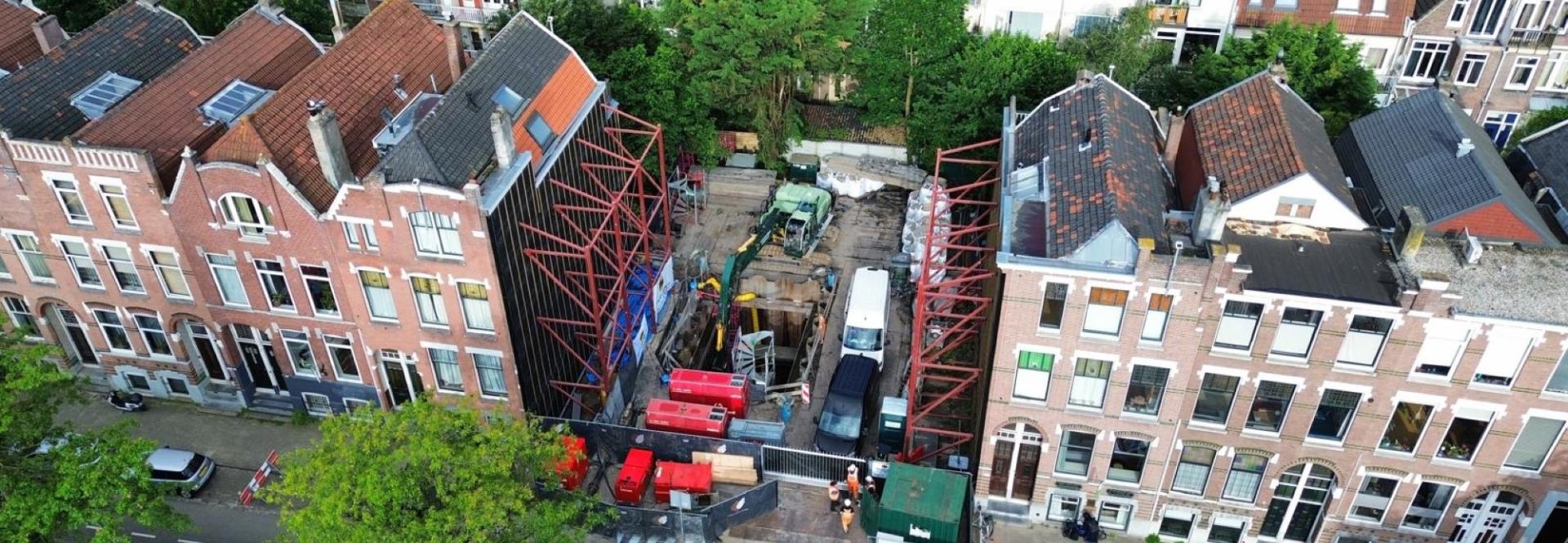
To remove the bomb, it was necessary to demolish 3 properties (6 homes). The demolition was completed in the fall of 2023. Then, in close cooperation with the Municipality of Rotterdam and the EOD, among others, we carried out the work necessary to excavate, defuse, dispose of and finally, destroy the bomb.

During the May 30 cull, some 1,100 residents in the immediate area had to leave their homes as a precaution. Safety first!

“Usually we find explosives in open areas, near airports or port areas, where only businesses have to close temporarily. Such a clearance has much less impact on the environment. Here the unexploded bomb is in the middle of a residential area and 1,100 people have to leave their homes. In addition, we will not know for sure what kind of bomb and detonator we are dealing with until May 30. We have assumed a thousand pounder, the heaviest caliber with the most explosives, so we will not have any surprises on Thursday.

Sergeant-Major Chris, Explosive Detection Service Defense.

Precision work on the square meter
To approach and clear a bomb lying some 8 meters below ground, heavy equipment was used. And to handle this well, in the tight space between the houses, our crane is specially equipped for this work with a hydraulic cabin elevation and LMB (last moment safety device).

With this hydraulic cab, it can be moved up 2.15 meters which gives the operator a better view of the work in the tub. The LMB made sure we can hoist safely.

In addition, a special building pit construction was devised and installed for this special work in collaboration with Gebr. De Koning. They did this with great precision and in the tight space around this bomb expertly and vibration-free by using a Silent Piler.

Decommissioning
After years of preparation, the day finally arrived on Thursday, May 30. After the bomb was fully exposed, it was excavated, identified and defused by the EOD. The bomb was then removed and transported and detonated on the Maasvlakte.

Next, we closed the depth gap between the houses again so that, foundation work could be started for the new buildings that will be built here.

Read here how colleague Anouk experienced this special project up close

Watch short Army documentary on bomb disposal