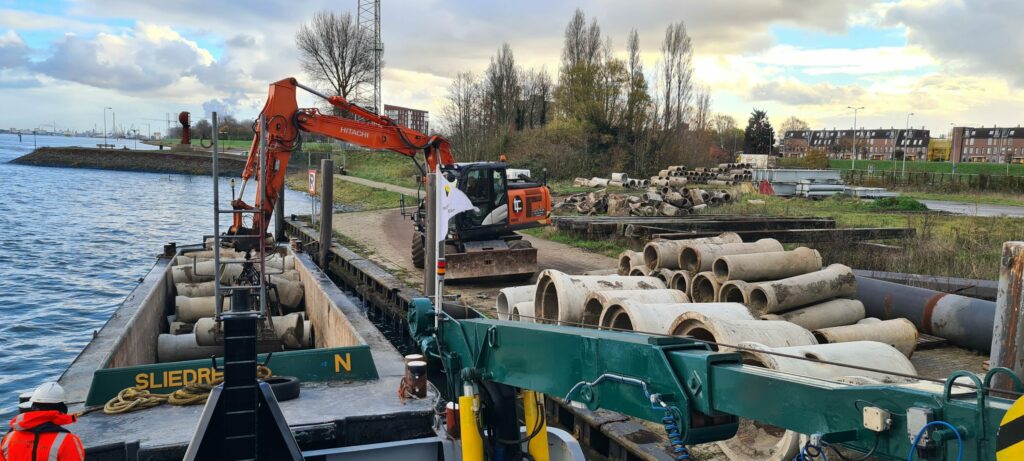
The sewer system in the city of Rotterdam is being replaced. Fortunately, all those old pipes are getting a new use. They are being used for the construction of no less than 4 km of longitudinal dams in the Nieuwe Waterweg, between the Maeslantkering and Rozenburg. A great example of circularity in hydraulic engineering!
Longitudinal dams are generally constructed with poured stone. In this case, the sewer pipes and manholes, so after a thorough cleaning, are used to build the dams. This saves a lot of material and CO2.
Beneficial to biodiversity
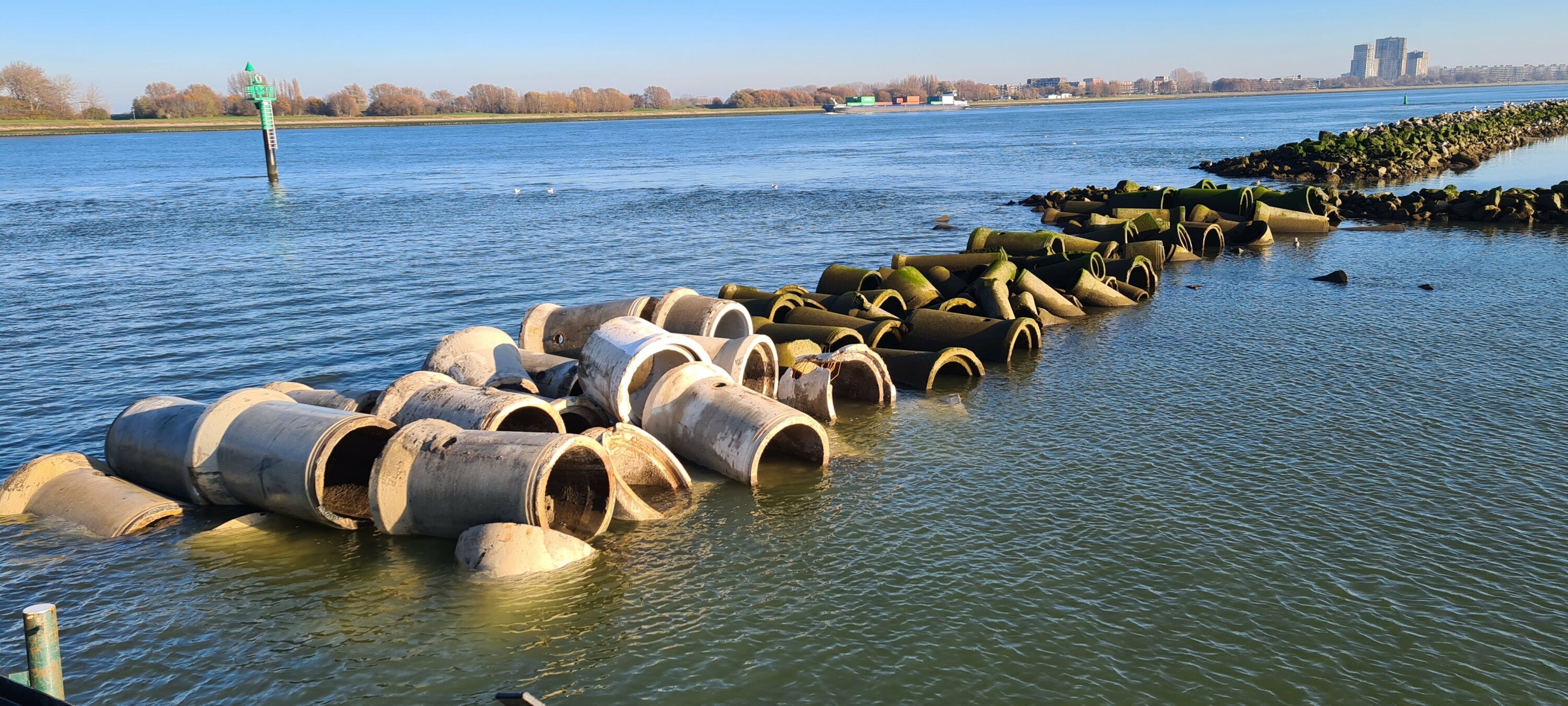
The longitudinal dams rise partially above the water, blocking wave action and currents. The use of sewer pipes creates a dam with uneven shapes and holes.
Both the lee area behind the dam and the dam itself are attractive to birds, aquatic plants, fish and other aquatic life. This makes the dam beneficial to biodiversity and ultimately to water quality.
The idea for this dam of sewage pipes comes from the project “The Green Gate. In this, Rijkswaterstaat, the Port of Rotterdam N.V., the Municipality of Rotterdam, WWF-Netherlands (World Wildlife Fund) and ARK Natuurontwikkeling are working together.
The dam was realized piece by piece by us. This is how we implement the Water Framework Directive together. In addition, it is a great example of reuse, which is something we are happy to contribute to!