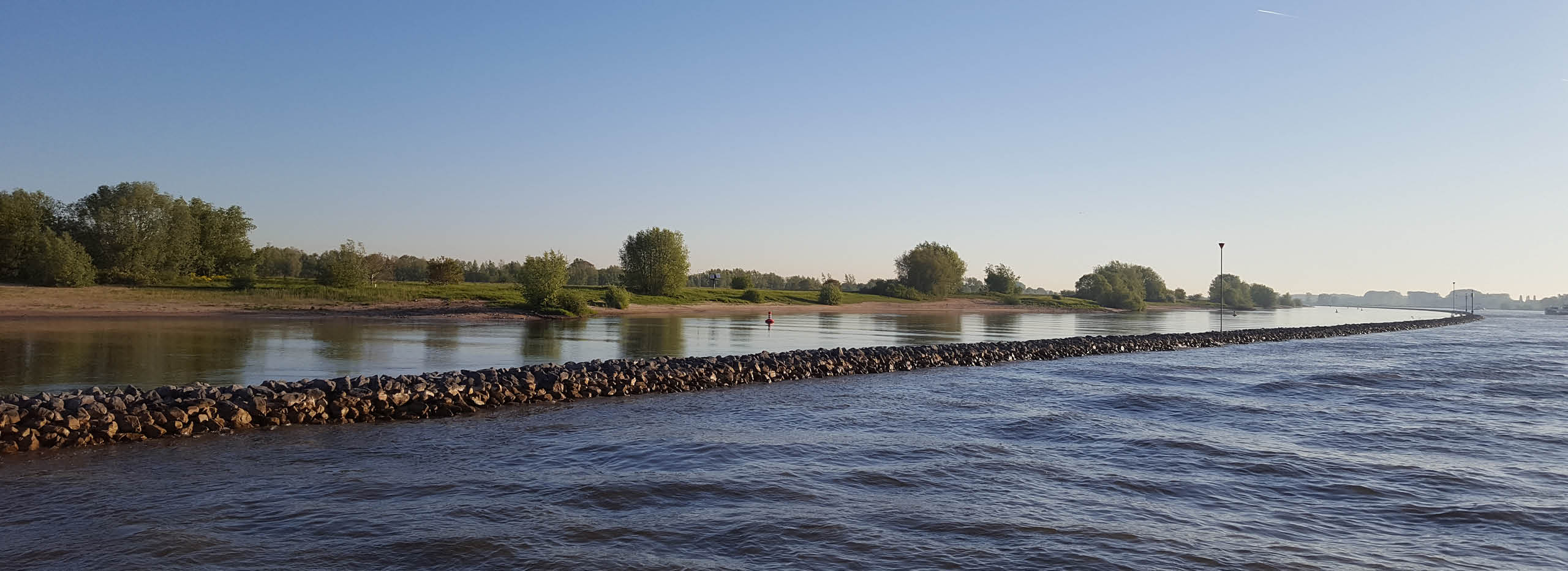
Groynes and harbor dams are crucial components of water infrastructure. They not only serve as protection from erosion, currents and tides, but also facilitate safe navigation and port operations.
As a hydraulic contractor, we have been involved in the construction or modification of groynes for many years. Starting in 2012, for example, we lowered 250 groynes and constructed longitudinal dams as part of the national high-water safety program Room for the River. Lowering groynes and longitudinal dams make it easier for the water on the Waal to find its way, while preserving the navigation channel.
Pilots with flexible groynes
In recent years we have conducted several pilots with the construction of flexible groynes, built with Xstream blocks. An initiative under the banner of the innovation program Self Supporting River System in cooperation with Rijkswaterstaat, among others.
flexible cribs
The flexible groyne is constructed from so-called Xstream blocks, a modular and adaptive system. When the blocks are applied, they hook together to form a sturdy structure. Anchoring is not required. The blocks can be easily picked up, making it easy to extend or raise the groyne.
Van den Herik protects ports and port activities with the construction and reinforcement of harbor dams. In Harlingen, for example, we reinforced the 350-meter-long section of the harbor dam by dumping break stone against it underwater. This keeps the trench immediately adjacent to the Noorderpier in place and prevents it from shifting towards the pier.
In addition, tidal pools have been installed here. In these pools the water remains after high tide, thus increasing biodiversity by providing shelter for all kinds of organisms. In addition, these pools are a food source for birds.
Advice and realization
As Van den Herik we not only realize, we also advise in possible solutions at harbor dams and work this out in-house into a realistic design with corresponding cost estimates. As a construction team partner for the municipality of Reimerswaal, we first worked out the definitive design for the port of Yerseke. We then also reached a realization agreement. Precisely because of our expertise of the execution, it became a feasible design.