


Defense Pipeline Organization (DPO) is part of the Defense Materiel Organization (DMO). DPO manages 550 kilometers of operational pipelines in the Netherlands, most of which are underground. Over 5 billion liters of kerosene flow through the pipelines annually. The pipeline system is part of the Central European Pipeline System (CEPS). This system of 5,400 kilometers of operational pipelines in Western Europe was developed by NATO in the mid-1950s. The purpose of the pipelines was to quickly supply troops at the front with fuel.
In the Hollandsch Diep, we are removing old pipelines from DPO. The pipelines are two 8-inch pipelines 3.5 kilometers long and are part of the Pernis-Woensdrecht connection. A replacement for the pipelines was constructed early this century, making the relics from the previous century obsolete.
Van den Herik is literally cut out for the job.
“Removing the old culverts is expensive and complex,” says Rob Bhaggoe of DPO, “A job like this has only been done once as far as we know, in the port of Rotterdam, also by Van den Herik-Sliedrecht.”
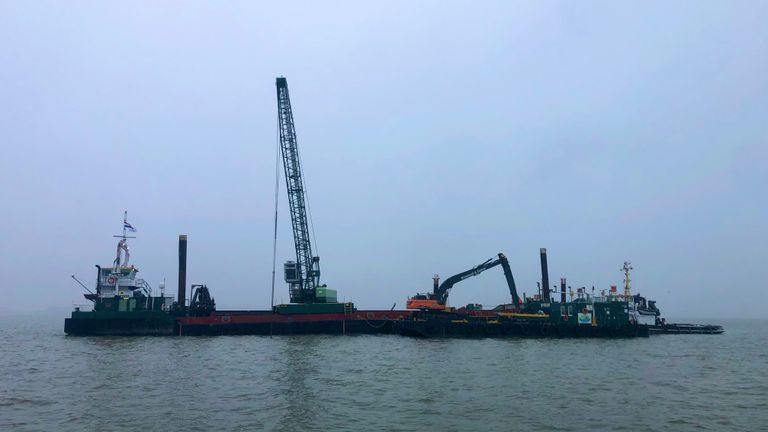
Of the 3.5 kilometers of pipeline, 2 kilometers lie in relatively shallow water (1 to 11 meters). Our crane vessel the Prince 1 was used to locate the pipeline. The ground coverage on the pipelines varies from 1 to 5 meters. Once the pipes are found, they are dredged up and then cut into pieces. The cutting of the pipes is done above a pontoon, this to make the work as environmentally conscious as possible. The old pipes are then transported to a certified processor using a bucket.
The remaining 1.5 kilometers of pipeline is on land, where three dikes are crossed. At two dikes, the pipeline follows the profile of the dike with 0.8 meters of ground cover. At one dike crossing, the primary levee at Willemstad, the dike was later constructed on top of the pipeline. In order to remove the pipelines there, the supply route to Willemstad would have to be closed so that the dike could be excavated. However, we managed to pull the pipes out of the dike without having to close the road. The holes were backfilled so that high-water safety is maintained.